Showing posts with label tourism. Show all posts

Friday, July 19, 2013

Astrologer's India: Venus and SriRangam Temple


Sri Ranganathaswamy Temple, also known as SriRangam, is notable for many reasons. It is the largest functioning Hindu temple in the world, covering an area on 156 acres. It is first and foremost among the 108 temples known as "Divya Desams", temples visited and glorified in the Divya Prabandha, the early medieval Tamil literature canon of the Alvar saints from the 6th–9th centuries AD. It also boasts the largest gopuram (temple tower) at 237 feet.

It also happens that SriRangam has special astrological significance, and is known as "Sukrasthalam." Prayers to Lord Ranganathar on Fridays can alleviate problems with one's natal Venus, also known as "Venus Dosha."

From the Sri Vaishavam Practices site:

Sukran is the planet which denotes all decorative items known as Alangara such as cosmetics, dresses, ornaments, sandals used in our life. Srirangam is the only temple where one could see the sandals (padhukas) of lord Sri Ranganathar in a storage place known as Kottaram nearby Dhanyalakshmi sannathi inside the temple. It is believed that Lord Sri Ranganatha regularly uses these sandals made by a cobbler, who makes it with due prayers for 48 days penance while observing strict viradam in the banks of river Kaveri, after the Lord himself gives them the measurement in the sands on the river bed. One could notice that those sandals undergoes wear and tear after some time, to prove that Sri Ranganather wear and use these sandals (divine padukas), walking inside the temple. These sandals are replaced every year by devotees. It is noteworthy to mention that Sri Desikan rendered versues known as slokams of 'Sri Ranganathar sahasram' in 1000 versues in praise the divinity of sacred sandals (divine padhukas) of Sri Ranganathar.

Here are some other ways in which SriRangam corresponds to Venus or Sukran, as per Kundandaiamudhan:

  • SriRangam is also associated with Revati Nakshatra. Lord Ranganathar's birth star is Revathi in Meena rasi (Moon sign as Pisces) in which Sukran is exalted.
  • Srirangam is also known as "boga mandapam." Venus is known ss the "boga karakan," or cause of enjoyment.
  • Srirangam has the biggest and tallest Garudan, and the bird Garudan represents Sukra. While Sukran's bird is given as Garuda, his animal is given as crocodile(makara.
  • The main idol, known as Moolavar, Sri Ranganathar put his feets on a lotus flower while reclining on the spiraling coils of Adisesha. The Lotus flower is the identified with and is a favorite of Venus.

    Below is a recording of the Sri Ranganathar Stotram sung by P.B Srinivas:

    You can find the text to this stotram here and with english translation here.

  • Churches and Convents of Goa: UNESCO World Heritage Sites


    When one thinks of Goa, one usually thinks of beaches overrun by hippies and other foreign tourists. But the area known as Old Goa is the center of what was a more than 400 year Portuguese stronghold and the bearer of its Catholic traditions and architecture.

    Old Goa is now mainly an archaeological site and open air museum. It is hard to imagine that this once was a city of 200,000 inhabitants. A clutter of churches, chapels and convents in different European architectural styles have survived. The churches and convents of Goa, the former capital of the Portuguese Indies, illustrate the evangelization of Asia. These monuments were influential in spreading forms of Manueline, Mannerist and Baroque art in all the countries of Asia where missions were established.

    The main buildings are:

  • St. Catherine’s Chapel
  • Church and Convent of Francis of Assisi
  • Sé Cathedral
  • Basilica of Bom Jesus
  • Church of Saint Cajetan including the seminary ,li>Church of Our Lady of the Rosary
  • St. Augustine Tower

    The Basilica of Bom Jesus holds the mortal remains of St. Francis Xavier who traveled across Asia as a missionary and died in 1552. In 1542 the Jesuits, who were driven by the ardour of medieval crusaders, arrived in the city and Francis Xavier, one of the founders of the Society of Jesus, rapidly became the patron saint of Goa. The churches in Old Goa aimed to awe the local population into conversion and to impress upon them the superiority of the foreign religion. The facades were accordingly made tall and lofty and the interiors were magnificent, with twisted Bernini columns, decorated pediments, profusely carved and gilded altars, and colourful wall paintings and frescoes. Once every decade his body is taken down for veneration and public viewing.

    The Portuguese explorer Alfonso de Albuquerque conquered Goa in 1510 and the Portuguese ruled the territory until 1961. The current churches in Goa date mainly from the Seventeenth century having taken a long time to establish or having replaced earlier structures. The tomb of St Francis Xavier in Bom Jesus was even sculpted in Italy by Foggini and shipped out to Goa in 1698.The main exception is the fortress-like Church of Our Lady of the Rosary which was completed in 1549 on the spot where Alphonse de Albuquerque masterminded his second and successful attempt to capture Goa after his defeat of the Muslim rulers.

    If you travel to Goa, be sure to explore these artifacts of India's Portuguese colonial heritage.
  • Wednesday, July 10, 2013

    Kerala Backwaters: Paradise At Your Fingertips


    The Kerala Backwaters are a network of interconnected canals, rivers, lakes and inlets forming a labyrinthine system of waterways. In the midst of this landscape there are a number of towns and cities, which serve as the starting and end points of backwater cruises.

    The backwaters have a unique ecosystem - freshwater from the rivers meets the seawater from the Arabian Sea. But what I find most fascinating about the Backwaters is that it is a major form of public transportation from village to village in this region.

    Indeed, traversing many of these canals is akin to riding a motorbike through narrow streets in rural neighborhoods. Many homes bank onto the waterways and one can witness the rhythm of daily life - feeding goats, milking cows, etc - in the same manner as when walking down a road in any residential area.

    An important feature of the Backwaters experience is the kettuvallams, or the Kerala houseboats, which are prominent tourist attractions in Kerala. The kettuvallams were traditionally used as grain barges, to transport the rice harvested in the fertile fields along the backwaters.

    Thatched roof covers over wooden hulls, 100 feet (30 m) in length, provided protection from the elements. At some point in time the boats were used as living quarters by the royalty. Converted to accommodate tourists who generally spend the night, the houseboats have become floating cottages having a sleeping area, with western-style toilets, a dining area and a sitting area on the deck. Food is cooked on board by the accompanying staff .

    Kerala has been placed among the '50 Destinations of a lifetime' by National Geographic Traveler. The Backwaters experience is an essential part of any South Indian itinerary.

    Monday, June 24, 2013

    Thanjavur Big Temple: The "MUST-SEE" Monument of South India


    "

    As you may have noticed, In this blog I try to steer away from India's well known monuments and sights. India has so much to offer in the realm of architectural monuments and historical edifices, that I tend to focus on the lesser known offerings.

    I consider the Peruvudaiyar Koil, or Brihadeeswara Temple of Thanajavur to be a well known monument. A british TV documentary has even been done on it. So why am I featuring it in this blog? I had a dream that I was on a journey to Thanjavur, and the name Brihadeeswara kept repeating over and over again throughout the dream until I woke up.

    The Brihadeeswara Temple was conceived by Emperor Raja Raja I (985-1013 AD) as the first of a series of great Tamil Chola building projects, and its foundations were laid in 1002 AD. The temple is the first building fully built by granite, the nearest sources of which are close to Tiruchchirapalli, about 60 km to the west of Thanjavur, and finished within 5yrs(1004AD – 1009 AD). The vimana or (temple tower) is 216 ft (66 m) high and is among the tallest of its kind in the world. The Kumbam (Kalasha or Chikharam) (apex or the bulbous structure on the top) of the temple is carved out of a single stone and weighs more than 80 tons.

    This temple was the tallest building in the world at the time that it was built.

    It is not my intention to make this the "go-to" article on the Brihadeeswara Temple, for that go to the Brihadeeswara Temple Site.

    An excellent route by which to see this temple is from Tiruchirappalli. One could do a three to five day exploration of SriRangam, The Rock Fort and other sites in Trichy, the Chola Temples in Thanjavur, Kumbakonam for Nava Graha Yatra, and on to Chidambaram to see the Nataraj Temple there.

    Sunday, June 16, 2013

    Mumbai Surprises: Maneckji Sett Agiary and The Elephanta Caves


    I have to admit that Mumbai is probably my least favorite city in India. I find it too expensive and way too modern. Indeed, except for the fact that it is full of Indians it feels like it could be any other modern city in any other part of the world.

    So imagine my surprise on finding just south of the Chatrapati Shivaji Terminal a real Zoroastrian Fire Temple! The Maneckji Sett Agiary or Fire Temple was built by the Parsi community in 1735. Except for the very interesting sculptures that flank the outside, the building itself is quite unremarkable.

    While catching up with my correspondence in an email cafe, I became engaged with a Slovakian tourist who was experiencing extreme gastrointestinal discomfort. I am an avid proponent of Acupuncture and Chinese Herbs, and had brought a boatload of Po Chai pills to combat just such a problem if I encountered it myself. As I offered him two vials of the pills I saw fascinating photos of caves with beautiful sculptures. I asked if he had just visited Ajanta or Ellora. He replied that he hadn't visited those sites yet, but had just returned from the Elephanta Caves. I asked where they were located, and practically fell off my chair when he told me they were "in Mumbai." I knew I had to see them.

    The Elephanta Caves are a network of sculpted caves located on Elephanta Island in Mumbai Harbour, 10 kilometers east of the city of Mumbai. The island, located on an arm of the Arabian Sea, consists of two groups of caves—the first is a large group of five Hindu caves, the second, a smaller group of two Buddhist caves. The Hindu caves contain rock cut stone sculptures dedicated to the god Shiva.

    The rock cut architecture of the caves has been dated to between the 5th and 8th centuries. All the caves were also originally painted in the past, but now only traces remain.

    The island was called Gharapuri (literally "the city of caves"), and was a Hindu place of worship until Portuguese rule began in 1534. The Portuguese called the island Elephanta on seeing its huge gigantic statue of an Elephant at the entrance.

    To get to the Elephanta Caves, go to the counter at the Gateway of India and buy a round trip ticket. There is a fee to get into the caves as well as another small fee that you pay on arriving on the island. It is very important that you do not take food or drinks because the place is crawling with monkeys. I've seen families on the boat who've packed lunches and expect to have a picnic there. The monkeys end up with the food!

    Friday, June 14, 2013

    Navagraha Temples of Tamil Nadu: An Astrologer's Pilgrimage


    As an astrologer, one of my dreams is to lead other astrologers on this pilgrimage to the Navagraha Temples around Kumbakonam in Tamil Nadu.

    Nava Graha is the sanskrit term for the 7 classical planets Moon to Saturn and the two "shadow planets" Rahu and Ketu, also know as the North and South Node. There are a cluster of temples dating from the Chola period (10th to 13th centuries) around Kumbakonam. 8 of them are actually Shiva temples. The Surya temple is the only one that is dedicated to the Graha itself.

    While others see things like the Taj Mahal, Agra Fort, Qutb Minar and the City Palace of Jaipur on their first journey to India, I went all the way to the southeastern tip of India to do this pilgrimage.

    To understand why, I should explain that India has the longest unbroken astrological tradition in the world. This astrological world view believes in an active Anima Mundi, or soul of the world, that recognizes, works with and acts upon us in response as we recognize,work with and act upon it. This is major aspect of hindu thought as well, where one performs homams, yagnas or pujas for certain results. As we participate with this force, it reciprocates and answers us. Part of this tradition includes assigning what are called "remedial measures" or remedies for problems in the natal chart. This can be done by doing things like wearing gemstones, repeating mantras, using yantras, or even doing mundane tasks like feeding a black dog. Making a pilgrimage to the Navagraha temples is also a form of remedial measure that gives a boost to the entire birth chart, as the pilgrim receives "darshan" of all of the planets.

    Darshan means "to view", and the thing that I learned when on this pilgrimage was that, by receiving Darshan, I wasn't just getting to view the deity, the deity also got to view me and take note of my respect and devotion.

    The journey was wonderful and scenic, especially at 6 am when we started out. Most of these temples are in small villages surrounding Kumbakonam, and the scenery is replete with Coconut trees and lush foliage. The temples are all in Southern Dravidian style. A few of them, like the Vaitheeswaram Koil, are archtecturally important with beautiful sculptures.

    A few of these temple experiences are worth noting. Most astrologers know that the planets have significations, or things that they represent. For instance, the Moon represents the color white. At the Chandra(Moon)shrine in Thingaloor, my driver and I were offered round white sweets. Mercury rules young people, and all of the pujaris at the Bhuda(Mercury)shrine in Thiruvenkadu were young boys. But I had the most amazing experience at Vaitheeswaram Koil, which is an extremely famous and powerful temple in it's own right. Vaitheeswaram Koil houses the Angkara(Mars) shrine. Mars rules war, contentions and the letting of blood. After taking off my shoes before entering the temple I immediately stubbed my toe, drawing blood. I hadn't even entered yet and walked into the temple with my bloody foot, realizing that the presence of Mars was permeating this entire site. The Angkara shrine was crowded with many pilgrims from all over India, and as I drew nearer I realized that all of them were arguing intensely!!! Mars was most certainly present in that place!

    As I mentioned, Vaitheeswaram Koil is a famous and important temple in it's own right. The site is also famous for a particular style of astrological reading called Nadi. These readings use your thumb print in order to find Nadi leaves that correspond to the print. The astrologer then does a reading based on what the leaves say. I didn't have a Nadi reading while I was there because I had heard that there are many charlatans there who just want to take your money, but I have since heard about a few reputable astrologers there who are supposed to be the real thing.

    Kumbakonam is easily reached by train and bus from Chennai and most other towns in Tamil Nadu. By the way, for non-vegetarians, I had one of the best Biryanis that I have ever tasted in Thirunallar, while waiting to get into the Sani (Saturn) Temple.

    The list of temples are as follows:

  • Surya Navagrahastalam -- Sooriyanar Kovil
  • Chandra Navagrahastalam -- Thingaloor
  • Angaarakan Navagrahastalam -- Vaitheeswaran Kovil
  • Budha Navagrahastalam -- Thiruvenkadu
  • Guru Navagrahastalam -- Alangudi
  • Sukra Navagrahastalam -- Kanjanur
  • Shani Navagrahastalam -- Thirunallar
  • Rahu Navagrahastalam -- Thirunageswaram
  • Thursday, June 13, 2013

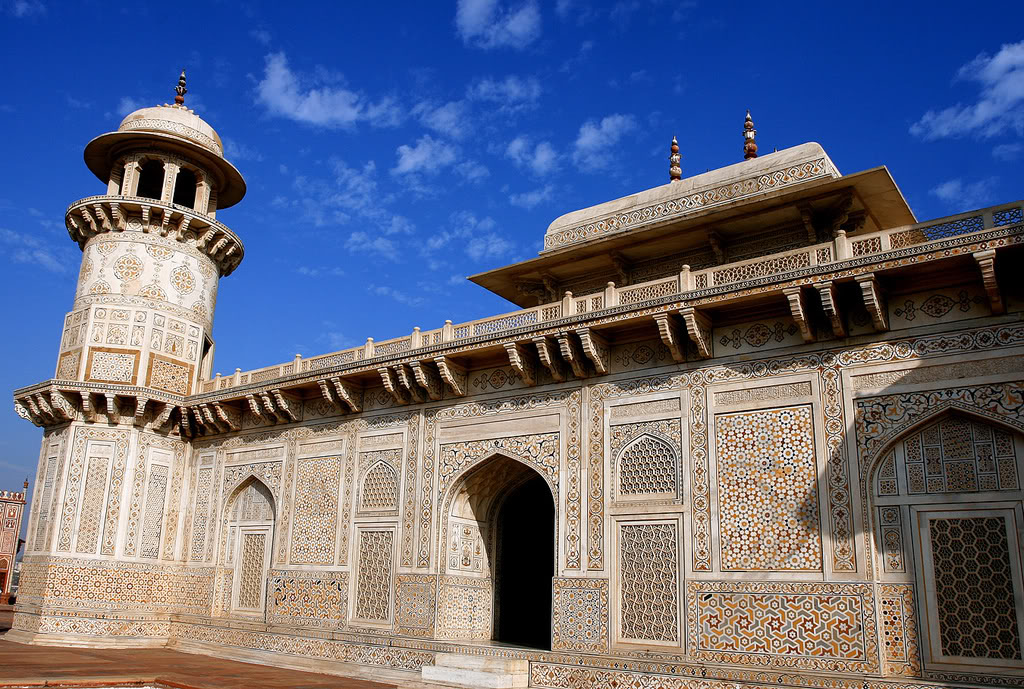
    I'timād-ud-Daulah: Agra's Other Architectural Miracle


    On everyone's first journey to India (except mine), one usually visits what is known as "The Golden Triangle": Delhi, Agra, Jaipur. You often hear that a person cannot visit India without seeing the Taj Mahal in Agra, and for the most part they are correct.

    However, just 6 kilometers away from the Taj Mahal, seated on the banks of the Yamuna river, is another Mausoleum known as the "jewel box" - I'timād-ud-Daulah.

    The mausoleum was commissioned by Nūr Jahān, the wife of Jahangir, for her father Mirzā Ghiyās Beg, who had been given the title of I'timād-ud-Daulah (pillar of the state). Mirzā Ghiyās Beg was also the grandfather of Mumtāz Mahāl, the wife of the emperor Shāh Jahān, for whom the Taj Mahal was constructed. Many of Nūr Jahān's relatives are interred in the mausoleum.

    Located on the left bank of the Yamuna river, the mausoleum is set in a large cruciform garden criss-crossed by water courses and walkways. The mausoleum itself covers about twenty-three meters square, and is built on a base about fifty meters square and about one meter high. On each corner are hexagonal towers, about thirteen meters tall.

    The first tomb to be built in white marble instead of red sandstone, it marks the departure from the red sandstone buildings of Mughal architecture. The walls are encrusted with semi-precious stone decorations in the pietra dura style. Cornelian, jasper, lapis lazuli, onyx, and topaz are formed into images of cypress trees and wine bottles, or more elaborate decorations like cut fruit or vases containing bouquets. Light penetrates to the interior through delicate jālī screens of intricately carved white marble.

    With so much emphasis on seeing the Taj Mahal, this monument can be easily overlooked. However, the good thing about that is fewer crowds and touts. Be sure to see it when you're there.

    Wednesday, June 12, 2013

    Pattadakal: Chalukya Capital and World Heritage Site in Karnataka


    Pattadakal was the capital of the Badami Chalukya Dynasty in Karnataka. From Wikipedia:

    The rule of the Chalukyas marks an important milestone in the history of South India and a golden age in the history of Karnataka. The political atmosphere in South India shifted from smaller kingdoms to large empires with the ascendancy of Badami Chalukyas. A Southern India based kingdom took control and consolidated the entire region between the Kaveri and the Narmada rivers. The rise of this empire saw the birth of efficient administration, overseas trade and commerce and the development of new style of architecture called "Chalukyan architecture"

    In 1987, Pattadakal was named a World Heritage Site by UNESCO. The architectural tradition begun by the Chalukyas, and continued by the Hoysala and Vijayanagara empires, created an amazing precedent that has since marked Karnataka as one of the most important centers of Temple architecture in all of India.

    Pattadakal has a set of nine temples built almost in a single file. Four of the temples here are in the south Indian Dravidian architectural style while four are in the north Indian Nagara style. Another temple exhibits a hybrid style known as Vesara style.

    The Virupaksha temple, pictured above, is in the south Indian style and is almost a replica of the Kailasanatha temple of Kanchi. While the Kailasanatha temple of Kanchi served as a model for this temple, this temple served as the model for the Ellora Kailasanatha temple in Maharashtra. It was built by Lokeswari one of the queens of Vikramaditya II in honor of his victorious battle against the Pallavas of Kanchi in the year 735 CE.

    The Mallikarjuna temple was built immediately after and close to the Virupaksha temple (It has a similar plan). Mallikarjuna temple was built in the Dravidian style. To the north of the Mallikarjuna temple is the temple of Kashivishveshvara of which only the sanctum and a passage is left. It was built by the Rashtrakutas in the 8th century in the Northern Nagara style.

    Pattadakal is 500 miles away from Bangalore, very close to Badami, another Chalukya stronghold. There are architectural sites of great interest interspersed all over Karnataka, and while travel in this state can be less convenient and luxurious, the results are extremely rewarding.

    Tuesday, June 11, 2013

    Kumbhalgarh: Second Longest Contiguous Wall in The World

    We all know that the Great Wall of China is the longest contiguous wall in the world, but did you know that the second longest wall is in Rajasthan, India?

    Kumbhalgarh Fort was conceived, designed and built by Rana Kumbh, a descendant of the Sisodia rulers of the Mewar kingdom of Rajasthan, in the 15th century . The fort stands 1100 meters above sea level, and its wall extends 36 kilometers.

    There is an interesting legend involving the construction of the wall. From Wikipedia:

    "According to legend, in 1443, the Maharana of Kumbhalgarh, Rana Kumbha, was initially repeatedly unsuccessful in attempts to build the fort wall. A spiritual preceptor was consulted about the construction problems and advised the ruler that a voluntary human sacrifice would solve whatever was causing the impediment. The spiritual advisor advised building a temple where the head should fall, and to build the wall and the fort where the rest of his body lay. As can be expected, for some time no one volunteered, but one day, a pilgrim, or some versions suggest a soldier, and some the spiritual preceptor and the pilgrim were one and the same, volunteered and was ritually decapitated. Today the main gate of the fortress, Hanuman Pol, contains a shrine and a temple to commemorate the great sacrifice."

    Compared to other places in Rajasthan, Kumbalgarh shows up on fewer people's itineraries, but it, along with the Jain temples at Ranakpur, makes an excellent daytrip from Udaipur.