Friday, June 14, 2013

Navagraha Temples of Tamil Nadu: An Astrologer's Pilgrimage


As an astrologer, one of my dreams is to lead other astrologers on this pilgrimage to the Navagraha Temples around Kumbakonam in Tamil Nadu.

Nava Graha is the sanskrit term for the 7 classical planets Moon to Saturn and the two "shadow planets" Rahu and Ketu, also know as the North and South Node. There are a cluster of temples dating from the Chola period (10th to 13th centuries) around Kumbakonam. 8 of them are actually Shiva temples. The Surya temple is the only one that is dedicated to the Graha itself.

While others see things like the Taj Mahal, Agra Fort, Qutb Minar and the City Palace of Jaipur on their first journey to India, I went all the way to the southeastern tip of India to do this pilgrimage.

To understand why, I should explain that India has the longest unbroken astrological tradition in the world. This astrological world view believes in an active Anima Mundi, or soul of the world, that recognizes, works with and acts upon us in response as we recognize,work with and act upon it. This is major aspect of hindu thought as well, where one performs homams, yagnas or pujas for certain results. As we participate with this force, it reciprocates and answers us. Part of this tradition includes assigning what are called "remedial measures" or remedies for problems in the natal chart. This can be done by doing things like wearing gemstones, repeating mantras, using yantras, or even doing mundane tasks like feeding a black dog. Making a pilgrimage to the Navagraha temples is also a form of remedial measure that gives a boost to the entire birth chart, as the pilgrim receives "darshan" of all of the planets.

Darshan means "to view", and the thing that I learned when on this pilgrimage was that, by receiving Darshan, I wasn't just getting to view the deity, the deity also got to view me and take note of my respect and devotion.

The journey was wonderful and scenic, especially at 6 am when we started out. Most of these temples are in small villages surrounding Kumbakonam, and the scenery is replete with Coconut trees and lush foliage. The temples are all in Southern Dravidian style. A few of them, like the Vaitheeswaram Koil, are archtecturally important with beautiful sculptures.

A few of these temple experiences are worth noting. Most astrologers know that the planets have significations, or things that they represent. For instance, the Moon represents the color white. At the Chandra(Moon)shrine in Thingaloor, my driver and I were offered round white sweets. Mercury rules young people, and all of the pujaris at the Bhuda(Mercury)shrine in Thiruvenkadu were young boys. But I had the most amazing experience at Vaitheeswaram Koil, which is an extremely famous and powerful temple in it's own right. Vaitheeswaram Koil houses the Angkara(Mars) shrine. Mars rules war, contentions and the letting of blood. After taking off my shoes before entering the temple I immediately stubbed my toe, drawing blood. I hadn't even entered yet and walked into the temple with my bloody foot, realizing that the presence of Mars was permeating this entire site. The Angkara shrine was crowded with many pilgrims from all over India, and as I drew nearer I realized that all of them were arguing intensely!!! Mars was most certainly present in that place!

As I mentioned, Vaitheeswaram Koil is a famous and important temple in it's own right. The site is also famous for a particular style of astrological reading called Nadi. These readings use your thumb print in order to find Nadi leaves that correspond to the print. The astrologer then does a reading based on what the leaves say. I didn't have a Nadi reading while I was there because I had heard that there are many charlatans there who just want to take your money, but I have since heard about a few reputable astrologers there who are supposed to be the real thing.

Kumbakonam is easily reached by train and bus from Chennai and most other towns in Tamil Nadu. By the way, for non-vegetarians, I had one of the best Biryanis that I have ever tasted in Thirunallar, while waiting to get into the Sani (Saturn) Temple.

The list of temples are as follows:

  • Surya Navagrahastalam -- Sooriyanar Kovil
  • Chandra Navagrahastalam -- Thingaloor
  • Angaarakan Navagrahastalam -- Vaitheeswaran Kovil
  • Budha Navagrahastalam -- Thiruvenkadu
  • Guru Navagrahastalam -- Alangudi
  • Sukra Navagrahastalam -- Kanjanur
  • Shani Navagrahastalam -- Thirunallar
  • Rahu Navagrahastalam -- Thirunageswaram
  • Thursday, June 13, 2013

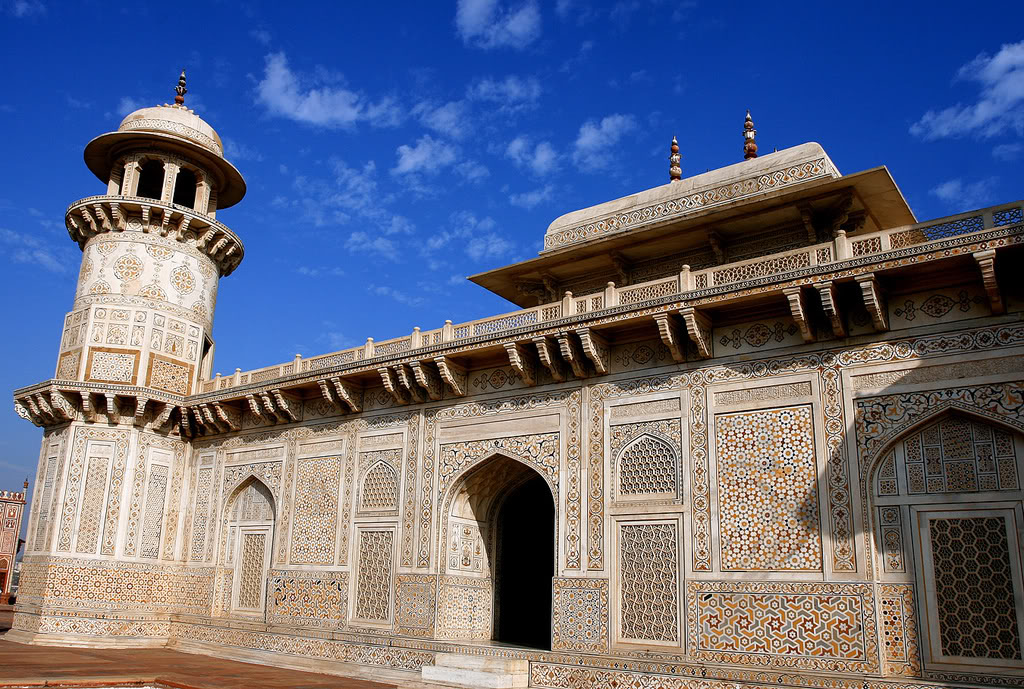
    I'timād-ud-Daulah: Agra's Other Architectural Miracle


    On everyone's first journey to India (except mine), one usually visits what is known as "The Golden Triangle": Delhi, Agra, Jaipur. You often hear that a person cannot visit India without seeing the Taj Mahal in Agra, and for the most part they are correct.

    However, just 6 kilometers away from the Taj Mahal, seated on the banks of the Yamuna river, is another Mausoleum known as the "jewel box" - I'timād-ud-Daulah.

    The mausoleum was commissioned by Nūr Jahān, the wife of Jahangir, for her father Mirzā Ghiyās Beg, who had been given the title of I'timād-ud-Daulah (pillar of the state). Mirzā Ghiyās Beg was also the grandfather of Mumtāz Mahāl, the wife of the emperor Shāh Jahān, for whom the Taj Mahal was constructed. Many of Nūr Jahān's relatives are interred in the mausoleum.

    Located on the left bank of the Yamuna river, the mausoleum is set in a large cruciform garden criss-crossed by water courses and walkways. The mausoleum itself covers about twenty-three meters square, and is built on a base about fifty meters square and about one meter high. On each corner are hexagonal towers, about thirteen meters tall.

    The first tomb to be built in white marble instead of red sandstone, it marks the departure from the red sandstone buildings of Mughal architecture. The walls are encrusted with semi-precious stone decorations in the pietra dura style. Cornelian, jasper, lapis lazuli, onyx, and topaz are formed into images of cypress trees and wine bottles, or more elaborate decorations like cut fruit or vases containing bouquets. Light penetrates to the interior through delicate jālī screens of intricately carved white marble.

    With so much emphasis on seeing the Taj Mahal, this monument can be easily overlooked. However, the good thing about that is fewer crowds and touts. Be sure to see it when you're there.

    Wednesday, June 12, 2013

    Pattadakal: Chalukya Capital and World Heritage Site in Karnataka


    Pattadakal was the capital of the Badami Chalukya Dynasty in Karnataka. From Wikipedia:

    The rule of the Chalukyas marks an important milestone in the history of South India and a golden age in the history of Karnataka. The political atmosphere in South India shifted from smaller kingdoms to large empires with the ascendancy of Badami Chalukyas. A Southern India based kingdom took control and consolidated the entire region between the Kaveri and the Narmada rivers. The rise of this empire saw the birth of efficient administration, overseas trade and commerce and the development of new style of architecture called "Chalukyan architecture"

    In 1987, Pattadakal was named a World Heritage Site by UNESCO. The architectural tradition begun by the Chalukyas, and continued by the Hoysala and Vijayanagara empires, created an amazing precedent that has since marked Karnataka as one of the most important centers of Temple architecture in all of India.

    Pattadakal has a set of nine temples built almost in a single file. Four of the temples here are in the south Indian Dravidian architectural style while four are in the north Indian Nagara style. Another temple exhibits a hybrid style known as Vesara style.

    The Virupaksha temple, pictured above, is in the south Indian style and is almost a replica of the Kailasanatha temple of Kanchi. While the Kailasanatha temple of Kanchi served as a model for this temple, this temple served as the model for the Ellora Kailasanatha temple in Maharashtra. It was built by Lokeswari one of the queens of Vikramaditya II in honor of his victorious battle against the Pallavas of Kanchi in the year 735 CE.

    The Mallikarjuna temple was built immediately after and close to the Virupaksha temple (It has a similar plan). Mallikarjuna temple was built in the Dravidian style. To the north of the Mallikarjuna temple is the temple of Kashivishveshvara of which only the sanctum and a passage is left. It was built by the Rashtrakutas in the 8th century in the Northern Nagara style.

    Pattadakal is 500 miles away from Bangalore, very close to Badami, another Chalukya stronghold. There are architectural sites of great interest interspersed all over Karnataka, and while travel in this state can be less convenient and luxurious, the results are extremely rewarding.

    Tuesday, June 11, 2013

    Kumbhalgarh: Second Longest Contiguous Wall in The World

    We all know that the Great Wall of China is the longest contiguous wall in the world, but did you know that the second longest wall is in Rajasthan, India?

    Kumbhalgarh Fort was conceived, designed and built by Rana Kumbh, a descendant of the Sisodia rulers of the Mewar kingdom of Rajasthan, in the 15th century . The fort stands 1100 meters above sea level, and its wall extends 36 kilometers.

    There is an interesting legend involving the construction of the wall. From Wikipedia:

    "According to legend, in 1443, the Maharana of Kumbhalgarh, Rana Kumbha, was initially repeatedly unsuccessful in attempts to build the fort wall. A spiritual preceptor was consulted about the construction problems and advised the ruler that a voluntary human sacrifice would solve whatever was causing the impediment. The spiritual advisor advised building a temple where the head should fall, and to build the wall and the fort where the rest of his body lay. As can be expected, for some time no one volunteered, but one day, a pilgrim, or some versions suggest a soldier, and some the spiritual preceptor and the pilgrim were one and the same, volunteered and was ritually decapitated. Today the main gate of the fortress, Hanuman Pol, contains a shrine and a temple to commemorate the great sacrifice."

    Compared to other places in Rajasthan, Kumbalgarh shows up on fewer people's itineraries, but it, along with the Jain temples at Ranakpur, makes an excellent daytrip from Udaipur.